
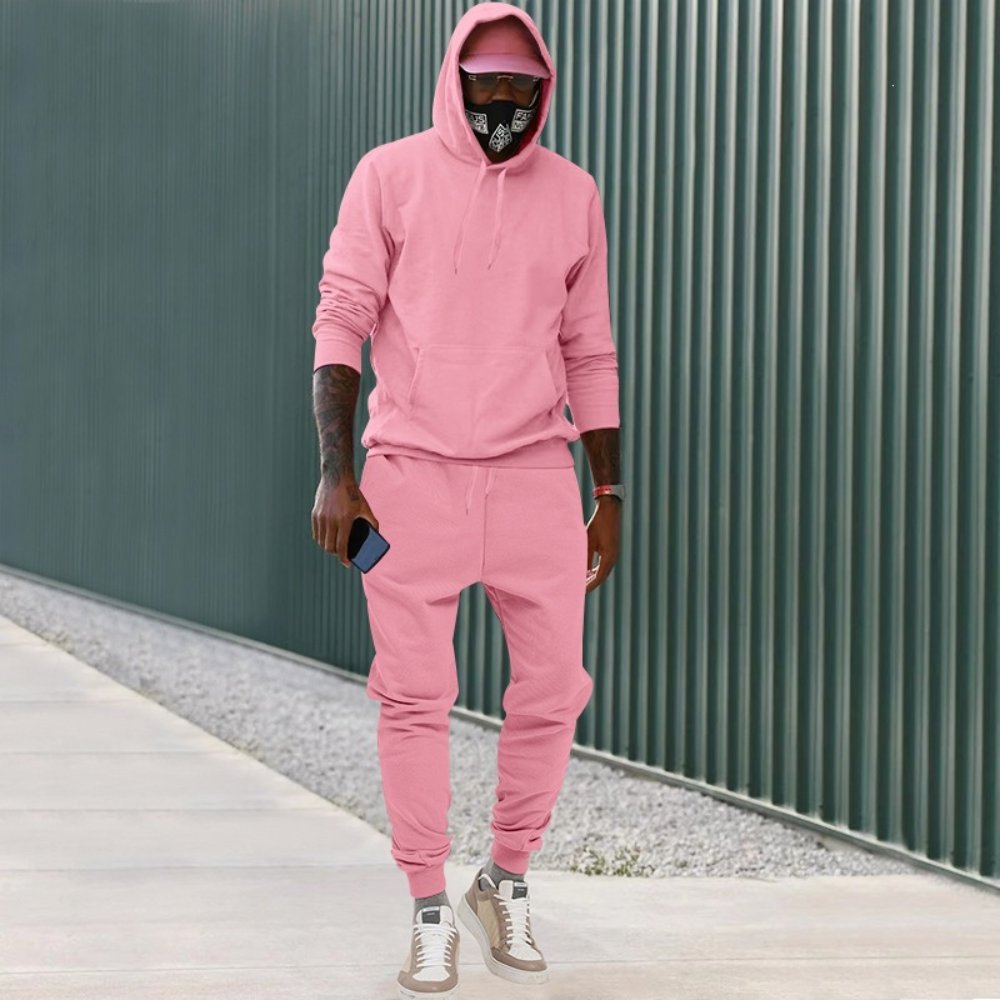
For a hoodie-and-sweatpants set RFQ, confirm the size code and measurement reference for each garment before approving the pair. Ask whether a set size means the same labelled size for both pieces or another supplier-defined combination. Lisheng Apparel’s listing identifies a hoodie-and-pants set, but the product photograph and a general dimensions entry do not replace separate garment size references for the offered top and bottom.
Identify the two garments in the offered set
Send the exact Lisheng set product link and ask the supplier to identify the hoodie and sweatpants versions being quoted together. Keep both garment identifiers beside the set reference. If another top or bottom is proposed, ask the supplier to identify that alternative rather than carrying the original pairing forward without explanation.
The official photograph shows a styled outfit on a model. Use it to locate the garment family, not to define every item included in the quote. A hat, eyewear, footwear or another styling accessory is not automatically part of the supplied set. Ask the supplier to state the actual included garments before moving to their size pairing.
Ask what a set size code actually combines
A set label does not explain the individual garment labels unless the supplier defines the combination. Ask whether the offered set uses the same size code for the hoodie and pants, or a separately stated pairing. Record the top code and bottom code on the same enquiry line so another buyer can understand the actual combination.
If the purchase needs different top and bottom codes, request that combination explicitly and ask whether it is available. Do not assume that mixed sizes are included in the standard offer. Keep any supplier-approved alternative pairing under its own reference so it does not become confused with a set assembled in the usual way.
Set reference | Buyer question | Supplier response requested
Hoodie version | Which top is supplied? | Garment identifier and labelled size
Pants version | Which bottom is supplied? | Garment identifier and labelled size
Set size | How are the two garment codes paired? | Explicit top-code and bottom-code combination
Top measurements | Which chart belongs to this hoodie? | Named measurements and measuring references
Bottom measurements | Which chart belongs to these pants? | Separate named measurements and conditions
Request a separate measurement reference for each piece
Ask for the hoodie size chart and the pants size chart as separately identified references. A top length does not describe a trouser length, and a chest reference does not define a waist measurement. Keep the garment name with each chart so numbers cannot be transferred to the wrong piece when the enquiry is copied into a purchasing record.
Where a measurement could be interpreted in more than one way, ask the supplier to show the endpoints or explain the measuring condition. For example, a buyer may need to distinguish a flat reference from a circumference, or clarify which condition applies to an adjustable or elastic area. Agree the needed reference rather than inventing an extension range or a fit tolerance.
Keep a general dimensions entry outside the garment chart
The listing contains a three-dimension entry alongside other product information. Those figures do not name the body measurements the buyer needs to compare a hoodie and pants. Ask the supplier what that entry describes, and keep it separate until its scope is clear. Do not relabel an unexplained dimensions entry as chest, waist or garment length.
The model image is also not a substitute for a size chart. It does not identify every garment measurement or establish how the same pair will fit another person. Use the supplier’s clearly named references to assess the purchase requirement, while leaving promotional fit language outside the measurement record.
• Record a garment identifier and size code for both pieces.
• Ask how the supplier defines each offered set-size pairing.
• Keep top and bottom measurement charts separately labelled.
• Clarify general dimensions before using them in a garment specification.
Connect the size pair to the offered appearance version
Ask the supplier to identify the actual colour or appearance reference for the paired garments. A styled photograph can help identify the enquiry, but it does not confirm that its apparent shade is an available order option. Keep the confirmed appearance reference beside the two size codes so the supplier’s response describes a complete offered combination.
A size-pair approval does not independently verify fabric composition, shrinkage or wear performance. The listing contains product descriptions, but any required material or performance information should be requested separately for the offered hoodie and pants. If the two garments use different references, keep those differences visible instead of assuming that a matching appearance proves identical specifications.
Send a clear top-and-bottom pairing enquiry
A practical request can read: For the linked hoodie set, please identify the top and bottom versions being offered and state their individual size codes. Explain how each set size pairs those codes, provide separately labelled garment measurement references and clarify what the general dimensions entry describes. Please identify any mixed-size proposal separately and confirm whether it can be supplied.
Ask the supplier to repeat the accepted pair reference in its final reply. If either garment version, size code or chart changes, request an updated pairing record for the affected combination. This gives the buyer a defined two-garment size decision without inventing availability, measurements, tolerances or a guaranteed fit outcome.
Frequently asked questions
Does one set size automatically mean identical top and bottom labels?
Ask the supplier to define the actual combination and record the two garment size codes explicitly.
Can mixed top and bottom sizes be assumed available?
No. Request the intended combination and obtain a supplier confirmation before treating it as an offered option.
Can a general dimensions entry replace the garment charts?
Clarify what it describes. Keep separately named hoodie and pants measurement references for the size decision.
Are the model’s styling accessories included?
Use the photograph as a reference and ask the supplier to list the actual garments or other items included in the quote.
Product and contact references
Product reference: https://lishengapparel.com/product/men-8217-s-hoodie-set/
Related apparel: https://lishengapparel.com/products/
Contact Lisheng Apparel: https://lishengapparel.com/contact/
Lisheng Apparel blog: https://lishengapparel.com/blog/